

What Is The Religion Makeup Of Montenegro
Coordinates: 42°30′Northward 19°xviii′E / 42.500°N xix.300°E / 42.500; nineteen.300
| Montenegro Crna Gora (Montenegrin) | |
|---|---|
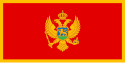
| Flag Coat of arms | |
| Anthem: Oj, svijetla majska zoro Ој, свијетла мајска зоро (English language: "Oh, Bright Dawn of May") | |
![Location of Montenegro (green) in Europe (dark grey) – [Legend]](https://upload.wikimedia.org/wikipedia/commons/thumb/b/b0/Europe-Montenegro.svg/250px-Europe-Montenegro.svg.png) Location of Montenegro (light-green) in Europe (dark gray) – [Legend] | |
| Capital and largest urban center | Podgorica 42°47′N xix°28′East / 42.783°N 19.467°E / 42.783; 19.467 |
| Official languages | Montenegrin[1] |
| Languages in official use |
|
| Indigenous groups (2011[three]) |
|
| Religion (2011) |
|
| Demonym(s) | Montenegrin |
| Authorities | Unitary parliamentary republic |
| • President | Milo Đukanović |
| • Prime number Minister | Dritan Abazović |
| • Speaker | Danijela Đurović |
| Legislature | Skupština |
| Institution history | |
| • Principality of Duklja | 625 |
| • Kingdom of Duklja | 1077 |
| • Lordship of Zeta | 1356 |
| • Prince-Bishopric | 1516 |
| • Principality proclaimed | 1852 |
| • Independence recognised | 1878 |
| • Kingdom proclaimed | 1910 |
| • Unification with Serbia | 1918 |
| • Socialist Republic | 1945 |
| • State union with Serbia | 1992 |
| • Independence restored | 2006 |
| Area | |
| • Full | 13,812 kmtwo (v,333 sq mi) (156th) |
| • Water (%) | 2.6 |
| Population | |
| • 2021 gauge |  620,739[4] (169th) 620,739[4] (169th) |
| • Density | 45/km2 (116.five/sq mi) (133rd) |
| GDP(PPP) | 2020 estimate |
| • Total | $11.994 billion[5] (149th) |
| • Per capita | $nineteen,252[5] (63rd) |
| GDP(nominal) | 2020 estimate |
| • Full | $iv.790 billion[5] (153rd) |
| • Per capita | $seven,688[5] (73rd) |
| Gini(2019) |  34.1[6] 34.1[6] medium |
| HDI(2019) |  0.829[seven] 0.829[seven] very loftier · 48th |
| Currency | Euro (€)a (EUR) |
| Time zone | UTC+one (CET) |
| • Summertime (DST) | UTC+2 (CEST) |
| Engagement format | dd.mm.yyyy. |
| Driving side | right |
| Calling lawmaking | +382 |
| ISO 3166 lawmaking | ME |
| Cyberspace TLD | .me |
| |

Montenegro (;[eight] Montenegrin: Crna Gora,[a] Црна Гора ,[b] lit.'Black Mountain')[9] [10] is a country in Southeastern Europe.[eleven] It is located on the Adriatic Ocean and is a part of the Balkans, sharing borders with Serbia to the northeast, Bosnia and Herzegovina to the north and west, Kosovo to the eastward, Albania to the southeast, the Adriatic Sea and Croatia to the southwest, and a maritime boundary with Italy.[12] Podgorica, the uppercase and largest city, covers 10.4% of Montenegro'south territory of 13,812 square kilometres (5,333 sq mi), and is home to roughly 30% of its full population of 621,000.[13]
During the Early Medieval period, 3 principalities were located on the territory of modern-mean solar day Montenegro: Duklja, roughly corresponding to the southern half; Travunia, the west; and Rascia proper, the north.[14] [15] [xvi] The Principality of Zeta emerged in the 14th and 15th centuries. From the late 14th century to the late 18th century, big parts of southern Montenegro were ruled by the Venetian Commonwealth and incorporated into Venetian Albania.[17] The name Montenegro was get-go used to refer to the state in the tardily 15th century. Later on falling under Ottoman dominion, Montenegro regained its independence in 1696 under the rule of the Firm of Petrović-Njegoš, first as a theocracy and after as a secular principality. Montenegro's independence was recognised by the Great Powers at the Congress of Berlin in 1878. In 1910, the country became a kingdom.
After Globe War I, the kingdom became part of Yugoslavia. Post-obit the breakup of Yugoslavia, the republics of Serbia and Montenegro together proclaimed a federation. Following an independence referendum held in May 2006, Montenegro declared its independence and the confederation dissolved.[eighteen]
Montenegro has an upper-center-income economic system[xix] and ranks 48th in the Homo Development Index.[20] It is a member of the United nations, NATO, the World Trade Organization, the Arrangement for Security and Co-performance in Europe, the Council of Europe, and the Central European Costless Trade Agreement.[21] Montenegro is also a founding member of the Union for the Mediterranean,[22] and is currently in the process of joining the European Marriage.[23]
Etymology [edit]

The country's English name derives from Venetian and translates equally "Black Mountain", deriving from the appearance of Mountain Lovćen when covered in dense evergreen forests.[24]
The native name Crna Gora, likewise meaning "blackness mount" or "black hill", was mentioned for the first time in a charter issued by Stefan Milutin.[25] It came to announce the majority of contemporary Montenegro in the 15th century.[26] Modern-day Montenegro was more than and more known past that proper name in the historical menstruum following the autumn of the Serbian Despotate.[27] Originally, it had referred to just a small strip of land under the rule of the Paštrovići tribe, only the name somewhen came to be used for the wider mountainous region after the Crnojević noble family took ability in Upper Zeta.[26] The aforementioned region became known as Stara Crna Gora 'Old Montenegro' past the 19th century to distinguish the independent region from the neighbouring Ottoman-occupied Montenegrin territory of Brda '(The) Highlands'. Montenegro farther increased its size several times by the 20th century, as the consequence of wars confronting the Ottoman Empire, which saw the annexation of Former Herzegovina and parts of Metohija and southern Raška. Its borders have changed petty since then, losing Metohija and gaining the Bay of Kotor.
Afterward the 2d session of the AVNOJ during World War II in Yugoslavia, the contemporary modern land of Montenegro was founded equally the Federal State of Montenegro (Montenegrin: Савезна држава Црне Горе / Savezna država Crne Gore) on 15 November 1943 inside the Yugoslav Federation past the ZAVNOCGB. After the war, Montenegro became a republic under its name, the People'due south Democracy of Montenegro (Montenegrin: Народна Република Црна Гора / Narodna Republika Crna Gora) on 29 November 1945. In 1963, it was renamed to the Socialist Democracy of Montenegro (Montenegrin: Социјалистичка Република Црна Гора / Socijalistička Republika Crna Gora). As the breakup of Yugoslavia occurred, the SRCG was renamed to the Republic of Montenegro (Montenegrin: Република Црна Гора / Republika Crna Gora) on 27 April 1992 inside the Federal Republic of Yugoslavia past removing the adjective "socialist" from the republic's title. Since 22 October 2007, a year after its independence, the proper noun of the country became simply known equally Montenegro.
History [edit]
Arrival of the Slavs [edit]
3 Slavic principalities were located on the territory: Duklja, roughly corresponding to the southern half, Travunia, the w, and Raška, the n.[14] [xv] Duklja gained its independence from the Byzantine Roman Empire in 1042. Over the next few decades, it expanded its territory to neighbouring Rascia and Bosnia, and also became recognised as a kingdom. Its ability started failing at the kickoff of the twelfth century. After King Bodin's expiry (in 1101 or 1108), several ceremonious wars ensued. Duklja reached its zenith under Vojislav'due south son, Mihailo (1046–81), and his grandson Constantine Bodin (1081–1101).[28]


Every bit the nobility fought for the throne, the kingdom was weakened, and by 1186, the territory of modern-solar day Montenegro became part of the state ruled by Stefan Nemanja and was a office of various state formations ruled by the Nemanjić dynasty for the next two centuries. After the Serbian Empire complanate in the second half of the 14th century, the nigh powerful Zetan family unit, the Balšićs, became sovereigns of Zeta.
By the 13th century, Zeta had replaced Duklja when referring to the realm. In the late 14th century, southern Montenegro (Zeta) came under the rule of the Balšić noble family unit, then the Crnojević noble family unit, and by the 15th century, Zeta was more often referred to equally Crna Gora (Venetian: monte negro ).
In 1421, Zeta was annexed to the Serbian Despotate, simply after 1455, another noble family unit from Zeta, the Crnojevićs, became sovereign rulers of the country, making it the last free monarchy of the Balkans before information technology fell to the Ottomans in 1496, and got annexed to the sanjak of Shkodër. During the reign of Crnojevićs, Zeta became known under its electric current proper name – Montenegro. For a short time, Montenegro existed every bit a separate autonomous sanjak in 1514–1528 (Sanjak of Montenegro). Also, Old Herzegovina region was part of Sanjak of Herzegovina.
Early modern menstruation [edit]

From 1392, numerous parts of the territory that is at present Montenegro were controlled by Republic of Venice, including the city of Budva, in that time known as "Budua". The Venetian territory was centred on the Bay of Kotor, and the Republic also introduced governors who meddled in Montenegrin politics. Venice would control territories in present-twenty-four hours Montenegro until its fall in 1797.[17] [29] [xxx]
Large portions fell under the control of the Ottoman Empire from 1496 to 1878. In the 16th century, Montenegro developed a unique class of autonomy within the Ottoman Empire permitting Montenegrin clans freedom from sure restrictions. Nevertheless, the Montenegrins were disgruntled with Ottoman rule, and in the 17th century, raised numerous rebellions, which culminated in the defeat of the Ottomans in the Great Turkish War at the end of that century.
Montenegro consisted of territories controlled by warlike clans. Most clans had a chieftain (knez), who was not permitted to assume the title unless he proved to be equally worthy a leader as his predecessor. The great assembly of Montenegrin clans (Zbor) was held every year on 12 July in Cetinje, and any developed clansman could accept part.[31] In 1515, Montenegro became a theocracy led by the Metropolitanate of Montenegro and the Littoral, which flourished subsequently the Petrović-Njegoš of Cetinje became the traditional prince-bishops (whose title was "Vladika of Montenegro").
People from Montenegro in this historical period have been described equally Orthodox Serbs.[32]
Principality and Kingdom of Montenegro [edit]
In 1858, one of the major Montenegrin victories over the Ottomans occurred at the Boxing of Grahovac. Yard Knuckles Mirko Petrović, elder brother of Knjaz Danilo, led an army of 7,500 and defeated the numerically superior Ottomans with 15,000 troops at Grahovac on ane May 1858. This forced the Great Powers to officially demarcate the borders between Montenegro and Ottoman Empire, de facto recognizing Montenegro'due south independence.
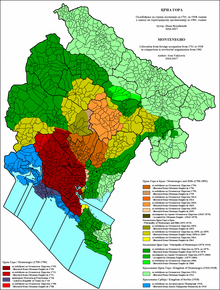
Expansion of Montenegro from 1711 to 1918 within present borders
In the Battle of Vučji Do Montenegrins inflicted major defeat to the Ottoman Regular army under K Vizier Ahmed Muhtar Pasha. In the aftermath of the Russian victory against the Ottoman Empire in the Russo-Turkish War of 1877–1878, the major powers restructured the map of the Balkan region. The Ottoman Empire recognised the independence of Montenegro in the Treaty of Berlin in 1878.
The first Montenegrin constitution (as well known every bit the Danilo Code) was proclaimed in 1855. Nether Nicholas I (ruled 1860–1918), the principality was enlarged several times in the Montenegro-Turkish Wars and was recognised every bit independent in 1878. Nicholas I established diplomatic relations with the Ottoman Empire.[ citation needed ] Minor border skirmishes excepted, affairs ushered in virtually 30 years of peace between the ii states until the degradation of Abdul Hamid Two in 1909.[33]
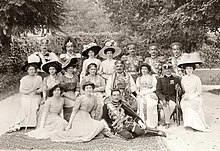
The political skills of Abdul Hamid Two and Nicholas I played a major role in the mutually amicable relations.[33] Modernization of the state followed, culminating with the typhoon of a Constitution in 1905. However, political rifts emerged between the reigning People's Party, who supported the process of democratisation and union with Serbia, and those of the True People'south Party, who were monarchist.
In 1910, Montenegro became a kingdom, and as a issue of the Balkan wars in 1912 and 1913, a common border with Serbia was established, with Shkodër being awarded to Albania, though the current capital letter urban center of Montenegro, Podgorica, was on the sometime border of Albania and Yugoslavia. Montenegro became i of the Allied Powers during World State of war I (1914–18). In the Battle of Mojkovac fought in January 1916 between Austria-Republic of hungary and the Kingdom of Montenegro, Montenegrins accomplished decisive victory despite beingness outnumbered v to one. From 1916 to October 1918 Austria-Hungary occupied Montenegro. During the occupation, Rex Nicholas fled the state and a regime-in-exile was set in Bordeaux.
Kingdom of Yugoslavia [edit]
In 1922, Montenegro formally became the Oblast of Cetinje in the Kingdom of Serbs, Croats and Slovenes, with the add-on of the coastal areas around Budva and Bay of Kotor. In a further restructuring in 1929, it became a role of a larger Zeta Banate of the Kingdom of Yugoslavia that reached the Neretva River.
Nicholas's grandson, the Serb King Alexander I, dominated the Yugoslav government. Zeta Banovina was one of nine banovinas that formed the kingdom; it consisted of the present-day Montenegro and parts of Serbia, Croatia, and Bosnia.
Earth State of war II and Socialist Yugoslavia [edit]
In April 1941, Nazi Germany, the Kingdom of Italy, and other Axis allies attacked and occupied the Kingdom of Yugoslavia. Italian forces occupied Montenegro and established it as a puppet Kingdom of Montenegro.
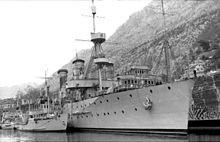
In May, the Montenegrin branch of the Communist Political party of Yugoslavia started preparations for an insurgence planned for mid-July. The Communist Political party and its Youth League organised half dozen,000 of its members into detachments prepared for guerrilla warfare. Co-ordinate to some historians, the get-go armed uprising in Nazi-occupied Europe happened on 13 July 1941 in Montenegro.[34]
Unexpectedly, the uprising took concord, and by 20 July, 32,000 men and women had joined the fight. Except for the coast and major towns (Podgorica, Cetinje, Pljevlja, and Nikšić), which were besieged, Montenegro was mostly liberated. In a month of fighting, the Italian army suffered 5,000 expressionless, wounded, and captured. The uprising lasted until mid-August, when it was suppressed by a counter-offensive of 67,000 Italian troops brought in from Albania. Faced with new and overwhelming Italian forces, many of the fighters laid down their arms and returned dwelling house. Notwithstanding, intense guerrilla fighting lasted until December.
Fighters who remained under arms fractured into two groups. Most of them went on to join the Yugoslav Partisans, consisting of communists and those inclined towards active resistance; these included Arso Jovanović, Sava Kovačević, Svetozar Vukmanović-Tempo, Milovan Đilas, Peko Dapčević, Vlado Dapčević, Veljko Vlahović, and Blažo Jovanović. Those loyal to the Karađorđević dynasty and opposing communism went on to become Chetniks, and turned to collaboration with Italians confronting the Partisans.
State of war bankrupt out between Partisans and Chetniks during the get-go half of 1942. Pressured by Italians and Chetniks, the cadre of the Montenegrin Partisans went to Serbia and Bosnia, where they joined with other Yugoslav Partisans. Fighting between Partisans and Chetniks continued through the war. Chetniks with Italian backing controlled most of the state from mid-1942 to April 1943. Montenegrin Chetniks received the status of "anti-communist militia" and received weapons, ammunition, food rations, and coin from Italy. Virtually of them were moved to Mostar, where they fought in the Boxing of Neretva confronting the Partisans, but were dealt a heavy defeat.
During the German operation Schwartz against the Partisans in May and June 1943, Germans disarmed a large number of Chetniks without fighting, equally they feared they would turn against them in case of an Allied invasion of the Balkans. After the capitulation of Italy in September 1943, Partisans managed to take concur of well-nigh of Montenegro for a cursory time, just Montenegro was shortly occupied past German forces, and fierce fighting continued during belatedly 1943 and entire 1944. Montenegro was liberated past the Partisans in December 1944.

Montenegro became one of the six elective republics of the communist Socialist Federal Republic of Yugoslavia (SFRY). Its capital became Podgorica, renamed Titograd in laurels of President Josip Broz Tito. Afterward the war, the infrastructure of Yugoslavia was rebuilt, industrialization began, and the University of Montenegro was established. Greater autonomy was established until the Socialist Republic of Montenegro ratified a new constitution in 1974.[35] [36]
Montenegro inside FR Yugoslavia [edit]
After the dissolution of the SFRY in 1992, Montenegro remained part of a smaller Federal Republic of Yugoslavia along with Serbia. In the plebiscite on remaining in Yugoslavia in 1992, the turnout was 66%, with 96% of the votes cast in favour of the federation with Serbia. The referendum was boycotted past the Muslim, Albanian, and Catholic minorities, too as the pro-independence Montenegrins. The opponents claimed that the poll was organised under anti-democratic atmospheric condition with widespread propaganda from the state-controlled media in favour of a pro-federation vote. No impartial report on the fairness of the referendum was made, as it was unmonitored, unlike in a later 2006 plebiscite when European Union observers were nowadays.
During the 1991–1995 Bosnian War and Croatian War, Montenegrin police and armed forces forces joined Serbian troops in the attacks on Dubrovnik, Croatia.[37] These operations, aimed at acquiring more than territory, were characterised by a consistent design of large-scale violations of human rights.[38]
Montenegrin Full general Pavle Strugar was convicted for his function in the bombing of Dubrovnik.[39] Bosnian refugees were arrested past Montenegrin police and transported to Serb camps in Foča, where they were subjected to systematic torture and executed.[40]
In 1996, Milo Đukanović'due south government severed ties betwixt Montenegro and its partner Serbia, which was led by Slobodan Milošević. Montenegro formed its ain economic policy and adopted the German Deutsche Mark every bit its currency and later on adopted the euro, although non function of the Eurozone. Subsequent governments pursued pro-independence policies, and political tensions with Serbia simmered despite the political changes in Belgrade.
Targets in Montenegro were bombed by NATO forces during Operation Allied Force in 1999, although the extent of these attacks was limited in both time and area affected.[41]
In 2002, Serbia and Montenegro came to a new understanding for connected cooperation and entered into negotiations regarding the future status of the Federal Democracy of Yugoslavia. This resulted in the Belgrade Agreement, which saw the country's transformation into a more decentralised state wedlock named Serbia and Montenegro in 2003. The Belgrade Agreement besides independent a provision delaying whatever time to come referendum on the independence of Montenegro for at to the lowest degree three years.
Independence [edit]
The status of the marriage between Montenegro and Serbia was decided by a referendum on Montenegrin independence on 21 May 2006. A total of 419,240 votes were cast, representing 86.v% of the full electorate; 230,661 votes (55.5%) were for independence and 185,002 votes (44.5%) were confronting.[42] This narrowly surpassed the 55% threshold needed to validate the plebiscite under the rules fix by the European Union. According to the electoral commission, the 55% threshold was passed by simply 2,300 votes. Serbia, the fellow member-states of the European Spousal relationship, and the permanent members of the Un Security Council all recognised Montenegro'due south independence.

Supporters of Montenegrin independence in June 2006 in Cetinje
The 2006 plebiscite was monitored past five international observer missions, headed by an OSCE/ODIHR squad, and around 3,000 observers in total (including domestic observers from CDT (OSCE PA), the Parliamentary Assembly of the Council of Europe (PACE), the Congress of Local and Regional Authorities of the Council of Europe (CLRAE), and the European Parliament (EP) to form an International Referendum Observation Mission (IROM). The IROM—in its preliminary written report—"assessed compliance of the referendum procedure with OSCE commitments, Council of Europe commitments, other international standards for democratic electoral processes, and domestic legislation." Furthermore, the study stated that the competitive pre-plebiscite environment was marked by an active and generally peaceful entrada and that "there were no reports of restrictions on central ceremonious and political rights."
On 3 June 2006, the Montenegrin Parliament declared the independence of Montenegro,[43] formally confirming the consequence of the plebiscite.
On 28 June 2006, Montenegro joined the United nations as its 192nd member state.[44]
The Constabulary on the Status of the Descendants of the Petrović Njegoš Dynasty was passed by the Parliament of Montenegro on 12 July 2011. It rehabilitated the Imperial House of Montenegro and recognised limited symbolic roles within the ramble framework of the commonwealth.
In 2015, the investigative journalists' network OCCRP named Montenegro'southward long-fourth dimension President and Prime number Minister Milo Đukanović "Person of the Year in Organized Criminal offense".[45] The extent of Đukanović's corruption led to street demonstrations and calls for his removal.[46] [47]
In October 2016, for the twenty-four hour period of the parliamentary election, a coup d'état was prepared by a group of persons that included leaders of the Montenegrin opposition, Serbian nationals and Russian agents; the coup was prevented.[48] In 2017, fourteen people, including two Russian nationals and two Montenegrin opposition leaders, Andrija Mandić and Milan Knežević, were indicted for their alleged roles in the coup try on charges such as "preparing a conspiracy against the constitutional order and the security of Montenegro" and an "attempted terrorist act."[49]
Recent history [edit]
Montenegro formally became a member of NATO in June 2017, though "Montenegro remains deeply divided over joining NATO",[fifty] an consequence that triggered a promise of retaliatory actions on the part of Russian federation's government.[51] [52] [53]
Montenegro has been in negotiations with the EU since 2012. In 2018, the earlier goal of acceding by 2022[54] was revised to 2025.[55]

In April 2018, Milo Djukanovic, the leader of the ruling Autonomous Party of Socialists (DPS), won Montenegro'southward presidential election. The veteran politician had served every bit Prime Minister six times and every bit President once before. He had dominated Montenegrin politics since 1991.[56]
The Montenegrin anti-corruption protests began in February 2019 confronting the incumbent President Milo Đukanović and the Prime Minister Duško Marković-led regime of the ruling Democratic Political party of Socialists (DPS), which had been in power since 1991.[57] [58]
As of late December 2019, the newly adopted Police on Religion, which de jure transfers the ownership of church buildings and estates built before 1918 from the Serbian Orthodox Church to the Montenegrin land,[59] [60] sparked a series of large[61] protests followed with route blockages.[62] Seventeen opposition Democratic Front MPs were arrested prior to the voting for disrupting the vote.[63] Demonstrations continued into March[64] 2020 as peaceful protestation walks, by and large organised by the Metropolitanate of Montenegro and the Littoral and the Eparchy of Budimlja and Nikšić in the bulk of Montenegrin municipalities.[65] [66] [67]
In its political rights and civil liberties worldwide written report in May 2020, Freedom House marked Montenegro every bit a hybrid regime rather than a democracy because of declining standards in governance, justice, elections, and media freedom.[68] [69] For the kickoff time in three decades, in the 2020 parliamentary election, the opposition won more than votes than Đukanović's ruling party.[70] In Feb 2022, that very same authorities was voted out in the first successful vote of no-confidence in the land'south history.[71]
Geography [edit]


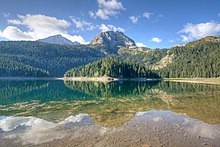
Montenegro ranges from high peaks forth its borders with Serbia, Kosovo, and Albania, a segment of the Karst of the western Balkan Peninsula, to a narrow littoral plain that is merely i.five to 6 kilometres (1 to 4 miles) wide. The plainly stops abruptly in the north, where Mount Lovćen and Mount Orjen plunge into the inlet of the Bay of Kotor.
Montenegro'due south large karst region lies generally at elevations of i,000 metres (iii,280 ft) above bounding main level; some parts, however, rise to 2,000 one thousand (6,560 ft), such as Mountain Orjen (1,894 m or 6,214 ft), the highest massif among the coastal limestone ranges. The Zeta River valley, at an elevation of 500 one thousand (one,600 ft), is the lowest segment.
The mountains of Montenegro include some of the nigh rugged terrains in Europe, averaging more than than ii,000 metres (half dozen,600 feet) in elevation. One of the land'due south notable peaks is Bobotov Kuk in the Durmitor mountains, which reaches a tiptop of 2,522 g (viii,274 ft). Owing to the hyperhumid climate on their western sides, the Montenegrin mount ranges were among the nearly ice-eroded parts of the Balkan Peninsula during the last glacial period.
Internationally, Montenegro borders Serbia, Bosnia and herzegovina, Kosovo,[c] Albania and Croatia . It lies between latitudes 41° and 44°North, and longitudes 18° and 21°E.
- Longest beach: Velika Plaža, Ulcinj – 13,000 thou (8.1 mi)
- Highest peak: Zla Kolata, Prokletije at ii,535 m (viii,317 ft)
- Largest lake: Skadar Lake – 391 km2 (151 sq mi) of surface area
- Deepest canyon: Tara River Canyon – 1,300 chiliad (iv,300 ft)
- Biggest bay: Bay of Kotor – 616 km2 (238 sq mi)
- Deepest cave: Iron Deep 1,169 m (three,835 ft), exploring started in 2012, now more than three,000 k (nine,800 ft) long[72]
| Name | Established | Area |
|---|---|---|
| Durmitor National Park | 1952 | 390 foursquare kilometres (39,000 ha) |
| Biogradska Gora National Park | 1952 | 54 square kilometres (5,400 ha) |
| Lovćen National Park | 1952 | 64 foursquare kilometres (6,400 ha) |
| Lake Skadar National Park | 1983 | 400 foursquare kilometres (40,000 ha) |
| Prokletije National Park | 2009 | 166 foursquare kilometres (16,600 ha) |
Montenegro is a member of the International Commission for the Protection of the Danube River, every bit more 2,000 km2 (772 sq mi) of the country's territory lie within the Danube catchment area.
Biodiversity [edit]
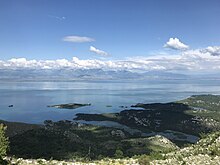
The diversity of the geological base, mural, climate, and soil, and the position of Montenegro on the Balkan Peninsula and Adriatic Sea, created the conditions for high biological diversity, putting Montenegro among the "hot-spots" of European and globe biodiversity. The number of species per area unit index in Montenegro is 0.837, which is the highest index recorded in any European state.[73]
Biological estimates suggest that over 1,200 species of freshwater algae, 300 species of marine algae, 589 species of moss, 7,000-8,000 species of vascular plants, two,000 species of fungi, 16,000-twenty,000 species of insects, 407 species of marine fish, 56 species of reptile, 333 species of regularly visiting birds and a high species diversity of mammals are found in Montenegro.[74]
Montenegro tin be divided into two main biogeographic regions, which include the Mediterranean Biogeographic Region and the Alpine Biogeographic Region.[74] It is also home to three terrestrial ecoregions: Balkan mixed forests, Dinaric Mountains mixed forests, and Illyrian deciduous forests.[75] It had a 2019 Wood Landscape Integrity Alphabetize mean score of half-dozen.41/10, ranking information technology 73rd globally out of 172 countries.[76]
The total share of protected areas in Montenegro is 9.05% of the country's surface area, which mainly comes from the 5 national parks of Montenegro.[74]
Government and politics [edit]
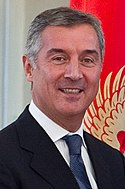

The Constitution of Montenegro describes the state every bit a "borough, democratic, ecological state of social justice, based on the reign of Law."[77] Montenegro is an independent and sovereign democracy that proclaimed its new constitution on 22 October 2007. The President of Montenegro is the caput of state, elected for a menstruation of five years through direct elections. The President represents the country away, promulgates laws by ordinance, calls elections for the Parliament, and proposes candidates for Prime number Minister, president and justices of the Constitutional Court to the Parliament. The President also proposes the calling of a referendum to Parliament, grants amnesty for criminal offences prescribed past the national law, confers ornament and awards and performs other ramble duties and is a member of the Supreme Defence force Council. The official residence of the President is in Cetinje.
The Authorities of Montenegro is the executive branch of government say-so of Montenegro. The authorities is headed by the Prime Government minister and consists of the deputy prime ministers as well as ministers.[78]

The Parliament of Montenegro is a unicameral legislative body. It passes laws, ratifies treaties, appoints the Prime Minister, ministers, and justices of all courts, adopts the budget and performs other duties equally established by the Constitution. Parliament can pass a vote of no-confidence in the Authorities past a elementary majority. Ane representative is elected per 6,000 voters.[79]
In 2019, the Freedom House reported that years of increasing country capture, corruption of power, and strongman tactics employed by the President Đukanović have tipped his state over the edge – for the start time since 2003, Montenegro is no longer categorised as democracy and became a hybrid authorities.[eighty] President Milo Djukanovic's pro-Western Democratic Party of Socialists (DPS) narrowly lost the 2020 Montenegrin parliamentary election, ending its 30-year rule.[81] The opposition, "For the Hereafter of Montenegro" (ZBCG) bloc, composed mainly of Serb nationalist parties.[82] The new pro-serbian government was formed by Prime Minister Zdravko Krivokapic. Notwithstanding, Prime number Minister Zdravko Krivokapic's government was toppled in no-confidence vote after only fourteen months in power.[83] In Apr 2022, a new minority authorities, comprising moderate parties that are both pro-European and pro-Serb, was formed. The new government was led past Prime Minister Dritan Abazovic.[84]
Foreign relations [edit]
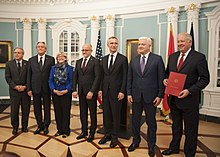
Signing of the protocol on Montenegro's accession to NATO. Montenegro officially became the 29th member of the NATO in 2017
Afterward the promulgation of the Declaration of Independence in the Parliament of the Republic of Montenegro on 3 June 2006, following the independence referendum held on 21 May, the Government of the Republic of Montenegro causeless the competencies of defining and conducting the foreign policy of Montenegro equally a subject of international law and a sovereign state. The implementation of this constitutional responsibleness was vested in the Ministry building of Foreign Affairs, which was given the job of defining the foreign policy priorities and activities needed for their implementation.
These activities are pursued in close cooperation with other state assistants authorities, the President, the Speaker of the Parliament, and other relevant stakeholders.[85]
Integration into the European Wedlock is Montenegro's strategic goal. This process volition remain in the focus of Montenegrin foreign policy in the brusque term. The 2nd strategic and as of import goal, just one accessible in a shorter time span, was joining NATO, which would guarantee stability and security for pursuing other strategic goals. Montenegro believes NATO integration would speed up EU integration.[85] In May 2017 NATO accustomed Montenegro as a NATO member starting v June 2017.[86]
Symbols [edit]
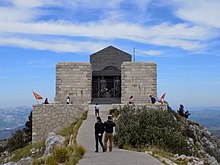
An official flag of Montenegro, based on the purple standard of King Nicholas I, was adopted on 12 July 2004 by the Montenegrin legislature. This royal flag was red with a silver edge, a silver coat of arms, and the initials НІ, in Cyrillic script (respective to NI in Latin script), representing Rex Nicholas I.[87] On the current flag, the edge and arms are in gold and the royal cipher in the centre of the artillery has been replaced with a golden lion.
The national day of thirteen July marks the date in 1878 when the Congress of Berlin recognised Montenegro every bit the 27th independent state in the world[88] and the start of one of the first pop uprisings in Europe against the Axis Powers on xiii July 1941 in Montenegro.
In 2004, the Montenegrin legislature selected a popular Montenegrin traditional song, "Oh, Bright Dawn of May", as the national canticle. Montenegro'southward official anthem during the reign of King Nicholas I was Ubavoj nam Crnoj Gori ("To Our Beautiful Montenegro").
Armed forces [edit]

The military of Montenegro is a fully professional standing army under the Ministry of Defence and is equanimous of the Montenegrin Basis Army, the Montenegrin Navy, and the Montenegrin Air Force, along with special forces. Conscription was abolished in 2006. The armed services currently maintains a forcefulness of 2,400 active duty members. The bulk of its equipment and forces were inherited from the armed forces of the Country Wedlock of Serbia and Montenegro; every bit Montenegro contained the entire coastline of the former spousal relationship, information technology retained practically the entire naval force.
Montenegro was a member of NATO's Partnership for Peace plan and so became an official candidate for full membership in the brotherhood. Montenegro applied for a Membership Action Programme on 5 November 2008, which was granted in Dec 2009. Montenegro is as well a fellow member of Adriatic Charter.[89] Montenegro was invited to bring together NATO on 2 December 2015 and on nineteen May 2016, NATO and Montenegro conducted a signing ceremony at NATO headquarters in Brussels for Montenegro'south membership invitation.[ninety] Montenegro became NATO'southward 29th member on 5 June 2017, despite Russia'south objections.[91] The government plans to have the army participate in peacekeeping missions through the UN and NATO such every bit the International Security Assistance Force.[92]
Administrative divisions [edit]
Montenegro is divided into twenty-four municipalities (opština). This includes 21 District-level Municipalities and 2 Urban Municipalities, with two subdivisions of Podgorica municipality, listed below. Each municipality tin can incorporate multiple cities and towns. Historically, the territory of the country was divided into "nahije".
Regions of Montenegro—designed purely for the statistical purposes by the Statistical Office—have no administrative use. Note that other organization (i.eastward. Football Association of Montenegro) use dissimilar municipalities as a role of like regions.
- Municipalities of Montenegro

-
- Northern Region
| Municipality | Surface area | Population | ||
|---|---|---|---|---|
| Km² | Rank | Total | Rank | |
| Andrijevica | 283 | 12 | v,117 | ten |
| Berane | 544 | 6 | 28,305 | 3 |
| Bijelo Polje | 924 | ii | 46,676 | 1 |
| Gusinje | 486 | 8 | 13,108 | half dozen |
| Kolašin | 897 | three | 8,420 | 8 |
| Mojkovac | 367 | 11 | eight,669 | vii |
| Petnjica | 173 | 13 | 6,686 | 9 |
| Plav | 486 | vii | 13,549 | 5 |
| Plužine | 854 | 4 | 3,286 | 12 |
| Pljevlja | 1,346 | 1 | 31,060 | 2 |
| Rožaje | 432 | x | 23,312 | iv |
| Šavnik | 553 | 5 | 2,077 | 13 |
| Žabljak | 445 | nine | 3,599 | 11 |
-
- Central Region
| Municipality | Area | Population | ||
|---|---|---|---|---|
| Km² | Rank | Total | Rank | |
| Cetinje | 899 | 3 | 16,757 | 4 |
| Danilovgrad | 501 | 4 | 17,678 | 3 |
| Nikšić | two,065 | 1 | 72,824 | ii |
| Podgorica | i,399 | 2 | 187,085 | 1 |
| Tuzi | 236 | five | 12,096 | 5 |
-
- Coastal Region
| Municipality | Area | Population | ||
|---|---|---|---|---|
| Km² | Rank | Full | Rank | |
| Bar | 598 | 1 | 42,368 | 1 |
| Budva | 122 | v | nineteen,170 | v |
| Herceg Novi | 235 | 4 | xxx,992 | 2 |
| Kotor | 335 | 2 | 22,799 | 3 |
| Tivat | 46 | 6 | fourteen,111 | 6 |
| Ulcinj | 255 | iii | xx,265 | four |
Economy [edit]
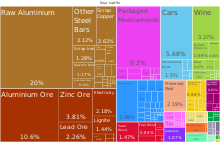
A proportional representation of Montenegro exports, 2019
The economic system of Montenegro is by and large service-based and is in belatedly transition to a market economic system. According to the Imf, the nominal GDP of Montenegro was $5.424 billion in 2019.[5] The Gdp PPP for 2019 was $12.516 billion, or $20,083 per capita.[five] According to Eurostat data, the Montenegrin GDP per capita stood at 48% of the European union boilerplate in 2018.[93] The Central Depository financial institution of Montenegro is non office of the euro system but the country is "euroised", using the euro unilaterally as its currency.
GDP grew at 10.vii% in 2007 and 7.5% in 2008.[94] The state entered a recession in 2008 every bit a function of the global recession, with Gdp contracting by 4%. However, Montenegro remained a target for foreign investment, the only country in the Balkans to increment its amount of direct foreign investment.[95] The country exited the recession in mid-2010, with GDP growth at around 0.five%.[96] Withal, the pregnant dependence of the Montenegrin economy on foreign direct investment leaves it susceptible to external shocks and a loftier export/import merchandise arrears.
In 2007, the service sector made upwardly 72.four% of GDP, with industry and agriculture making upwardly the rest at 17.6% and 10%, respectively.[97] There are 50,000 farming households in Montenegro that rely on agronomics to fill the family upkeep.[98]
Infrastructure [edit]

The Montenegrin road infrastructure is non yet at Western European standards. Despite an extensive road network, no roads are built to full state highway standards. Construction of new motorways is considered a national priority, as they are important for uniform regional economic development and the development of Montenegro as an attractive tourist destination.
Electric current European routes that laissez passer through Montenegro are E65 and E80.
The backbone of the Montenegrin rail network is the Belgrade–Bar railway, which provides international connection towards Serbia. At that place is a domestic branch line, the Nikšić-Podgorica railway, which was operated as a freight-only line for decades, and is now also open for passenger traffic afterward the reconstruction and electrification works in 2012. The other branch line from Podgorica towards the Albanian border, the Podgorica–Shkodër railway, is not in apply.
Montenegro has two international airports, Podgorica Airport and Tivat Airport.
The Port of Bar is Montenegro's main seaport. Initially congenital in 1906, the port was about completely destroyed during World State of war II, with reconstruction beginning in 1950. Today, it is equipped to handle over five million tons of cargo annually, though the breakup of the quondam Yugoslavia and the size of the Montenegrin industrial sector has resulted in the port operating at a loss and well below capacity for several years. The reconstruction of the Belgrade-Bar railway and the proposed Belgrade-Bar motorway are expected to bring the port support to chapters.
Tourism [edit]

With a full of 1.6 1000000 visitors, Montenegro was, every bit of 2017, the 36th-most-visited country (out of 47) in Europe.[99] The majority of strange visitors to Montenegro come from the neighbouring countries of Serbia, Republic of bosnia and herzegovina and Kosovo, as well every bit Russia.[100] The Montenegrin Adriatic coast is 295 km (183 mi) long, with 72 km (45 mi) of beaches and many well-preserved ancient old towns. Some of the well-nigh popular beaches on the Montenegrin declension include Jaz Beach, Mogren Beach, Bečići Beach, Sveti Stefan Beach and Velika Plaža.[101] Meanwhile, some of the most popular ancient Montenegrin towns include Herceg Novi, Perast, Kotor, Budva and Ulcinj.[102]
National Geographic Traveler (edited once a decade) ranks Montenegro among the "50 Places of a Lifetime", and the Montenegrin seaside Sveti Stefan was used as the embrace for the mag.[103] The declension region of Montenegro is considered one of the neat new "discoveries" among world tourists. In January 2010, The New York Times ranked the Ulcinj South Coast region of Montenegro, including Velika Plaža, Ada Bojana, and the Hotel Mediteran of Ulcinj, amongst the "Height 31 Places to Get in 2010" as function of a worldwide ranking of tourism destinations.[104]
Montenegro was also listed past Yahoo Travel amongst the "10 Top Hot Spots of 2009" to visit, describing it as being "[c]urrently ranked as the second fastest growing tourism market in the earth (falling just backside Communist china)".[105] It is listed every year by prestigious tourism guides like Lone Planet equally a top tourist destination along with Greece, Spain and other popular locations.[106] [107]
Demographics [edit]
Indigenous structure [edit]

Ethnic structure of Montenegro past settlements, 2011[108]
According to the 2003 census, Montenegro has 620,145 citizens. If the methodology used up to 1991 had been adopted in the 2003 census, Montenegro would officially have recorded 673,094 citizens. The results of the 2011 demography evidence that Montenegro had 620,029 citizens.[109] Most inhabitants of the United States who originate from Montenegro identify as Serbs rather than Montenegrins. According to the U.S. Census Agency, in 2015, there were ix,486 ethnic Serbs built-in in "Other Eastern Europe" countries, overwhelmingly Montenegro.[110] Co-ordinate to the 2000 U.South. demography, there were ii,339 individuals whose first beginnings was Montenegrin, and 189 whose second ancestry was Montenegrin, 2,528 ethnic Montenegrins overall.[111]
Montenegro is a multiethnic state in which no indigenous group forms a bulk.[112] [113] Major indigenous groups include Montenegrins (Црногорци/Crnogorci) and Serbs (Срби/Srbi); others are Bosniaks (Bošnjaci), Albanians (Albanci – Shqiptarët) and Croats (Hrvati). The number of "Montenegrins" and "Serbs" fluctuates widely from census to census due to changes in how people perceive, experience, or cull to express, their identity and ethnic affiliation.[114] [115] [116]
Languages [edit]
The official language in Montenegro is Montenegrin. Also, Serbian, Bosnian, Albanian, and Croatian are recognised in usage. Montenegrin, Serbian, Bosnian, and Croatian are mutually intelligible, all being standard varieties of the Serbo-Croatian linguistic communication. Montenegrin is the plurality mother-natural language of the population under eighteen years of historic period.[117] Previous constitutions endorsed Serbo-Croatian as the official linguistic communication in SR Montenegro and Serbian of the Ijekavian standard during the 1992–2006 period.
Religion [edit]

Religious structure of Montenegro by settlements, 2011[108]
Montenegro has been historically at the crossroads of multiculturalism and over centuries this has shaped its unique form of co-existence between Muslim and Christian populations.[118] Montenegrins have been, historically, members of the Serbian Orthodox Church building (governed by the Metropolitanate of Montenegro and the Littoral), and Serbian Orthodox Christianity is the most pop faith today in Montenegro. The Montenegrin Orthodox Church was recently founded and is followed past a small minority of Montenegrins although information technology is non in communion with any other Christian Orthodox Church as it has not been officially recognised.
Despite tensions betwixt religious groups during the Bosnian War, Montenegro remained fairly stable, mainly due to its population having a historic perspective on religious tolerance and faith diversity.[119] Religious institutions from Montenegro all have guaranteed rights and are separate from the country. The second largest faith is Islam, which amounts to nineteen% of the total population of the country. Montenegro has the sixth-highest proportion of Muslims in Europe, after Kosovo (96%), Turkey (90%), Republic of albania (60%), Bosnia and Herzegovina (51%), and Due north Macedonia (34%), and Montenegro has the 3rd highest proportion among Slavic countries, behind just Bosnia and herzegovina and North Republic of macedonia. A petty more than 1-fourth of the country's Albanians are Catholics (8,126 in the 2004 demography) while the rest (22,267) are mainly Sunni Muslims; in 2012 a protocol passed that recognises Islam as an official faith in Montenegro, ensures that halal foods will exist served at military machine facilities, hospitals, dormitories and all social facilities; and that Muslim women volition be permitted to wear headscarves in schools and at public institutions, as well equally ensuring that Muslims have the right to take Fridays off work for the Jumu'ah (Friday)-prayer.[120] Since the fourth dimension of Vojislavljević dynasty Catholicism is autochthonous in the Montenegrin area.[121] At that place is also a modest Roman Catholic population, mostly Albanians with some Croats, divided between the Archdiocese of Antivari headed past the Primate of Serbia and the Diocese of Kotor that is a part of the Cosmic Church in Croatia.
Culture [edit]

The culture of Montenegro has been shaped by a variety of influences throughout history. The influence of Orthodox, Ottoman (Turk), Slavic, Central European, and seafaring Adriatic cultures (notably parts of Italy, like the Republic of Venice) have been the most of import in recent centuries.
Montenegro has many meaning cultural and historical sites, including heritage sites from the pre-Romanesque, Gothic and Baroque periods. The Montenegrin coastal region is particularly well known for its religious monuments, including the Cathedral of Saint Tryphon in Kotor[122] (Cattaro under the Venetians), the basilica of St. Luke (over 800 years), Our Lady of the Rocks (Škrpjela), the Savina Monastery and others. Medieval monasteries comprise a number of artistically important frescoes.
A dimension of Montenegrin culture is the upstanding ideal of Čojstvo i Junaštvo, "Humaneness and Gallantry".[123] [124] The traditional folk dance of the Montenegrins is the Oro, the "eagle dance" that involves dancing in circles with couples alternate in the centre, and is finished by forming a man pyramid by dancers continuing on each other'due south shoulders.
Media [edit]
The media of Montenegro refers to mass media outlets based in Montenegro. Tv, magazines, and newspapers are all operated by both state-owned and for-profit corporations which depend on advertising, subscription, and other sales-related revenues. The Constitution of Montenegro guarantees liberty of speech. As a country in transition, Montenegro's media organisation is under transformation.
Sport [edit]
Sport in Montenegro revolves more often than not around squad sports, such as h2o polo, football, basketball, handball, and volleyball. Other sports involved are boxing, tennis, pond, judo, karate, athletics, table lawn tennis, and chess.
Water polo is the most popular sport in Montenegro, and is considered the national sport.[125] Montenegro men's national water polo team is ane of the meridian ranked teams in the world, winning the aureate medal at the 2008 Men's European Water Polo Championship in Málaga, Spain, and winning the gold medal at the 2009 FINA Men'southward Water Polo World League, which was held in the Montenegrin uppercase, Podgorica. The Montenegrin squad PVK Primorac from Kotor became a champion of Europe at the LEN Euroleague 2009 in Rijeka, Croatia. Football game is the 2nd well-nigh popular sport in Montenegro.[125] Notable football game players from Montenegro are Dejan Savićević, Predrag Mijatović, Mirko Vučinić, Stefan Savić, Stevan Jovetić, and Stefan Mugoša. Montenegrin national football squad, founded in 2006, played in playoffs for UEFA Euro 2012, which is the biggest success in the history of the national team. The Montenegro national basketball squad is too known for adept performances and had won a lot of medals in the by as part of the Yugoslavia national basketball game squad. In 2006, the Basketball game Federation of Montenegro along with this team joined the International Basketball Federation (FIBA) on its own, post-obit the Independence of Montenegro. Montenegro participated on 2 Eurobaskets until now.
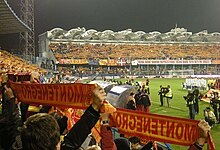
Amidst women sports, the national handball squad is the nearly successful, having won the 2012 European Title and finishing as runners-upwardly at the 2012 Summer Olympics. ŽRK Budućnost Podgorica won 2 times EHF Champions League.
Chess is another popular sport and some famous global chess players, like Slavko Dedić, were born in Montenegro.
At the 2012 Olympic Games in London, the Montenegro women'southward national handball team won the state's first Olympic medal by winning silver. They lost in the terminal to the defending world, Olympic, and European champion Norway 26–23. Post-obit this defeat the team won against Norway in the final of the 2012 European Championship, condign champions for the starting time time.
Public holidays [edit]
| Appointment | Name | Notes |
|---|---|---|
| 1 Jan | New year's day | (non-working) |
| vii January | Orthodox Christmas | (non-working) |
| thirty Apr * | Orthodox Good Fri | (not-working) |
| 1 May | Labour Day | (non-working) |
| iii May * | Orthodox Easter Mon | (non-working) |
| ix May | Victory Mean solar day | (non-working) |
| 21 May | Independence Day | (not-working) |
| 13 July | Statehood Mean solar day | (not-working) |
*2021 dates – exact dates vary each year according to the Orthodox agenda
Run into also [edit]
- Montenegro existent manor taxes
- Outline of Montenegro
Notes [edit]
- ^ Written identically in other Serbo-Croatian languages.
- ^ Written identically in Serbian Cyrillic.
- ^ The political status of Kosovo is disputed. Having unilaterally declared independence from Serbia in 2008, Kosovo is formally recognised as an contained state by 97 UN member states (with another 15 states recognising information technology at some bespeak but so withdrawing their recognition), while Serbia continues to merits information technology as role of its own sovereign territory.
References [edit]
- ^ "Linguistic communication and alphabet Article thirteen". Constitution of Montenegro. WIPO. 19 Oct 2007.
The official language in Montenegro shall be Montenegrin. Cyrillic and Latin alphabet shall exist equal.
- ^ "Language and alphabet Article xiii". Constitution of Montenegro. WIPO. 19 October 2007.
Montenegrian, Albanian and Croatian shall also be in the official apply.
- ^ "Demography of Population, Households and Dwellings in Montenegro 2011" (PDF). Monstat. Retrieved 12 July 2011.
- ^ "Statistical Office of Montenegro – MONSTAT". world wide web.monstat.org.
- ^ a b c d east f "Report for Selected Countries and Subjects". International monetary fund.org. International Budgetary Fund. April 2021. Retrieved 19 September 2021.
- ^ "Gini coefficient of equivalised disposable income – Eu-SILC survey". ec.europa.eu. Eurostat. Retrieved 24 August 2021.
- ^ Human Development Report 2020 The Next Frontier: Human Development and the Anthropocene (PDF). United Nations Development Programme. 15 December 2020. pp. 343–346. ISBN978-92-1-126442-five . Retrieved sixteen December 2020.
- ^ Jones, Daniel (2011). Roach, Peter; Setter, Jane; Esling, John (eds.). Cambridge English Pronouncing Dictionary (18th ed.). Cambridge University Press. ISBN978-0-521-15255-6.
- ^ "Влада Црне Горе". Vlada Crne Gore (in Montenegrin). Archived from the original on 14 May 2021. Retrieved 9 April 2021.
- ^ "Vlada Crne Gore". Влада Црне Горе (in Montenegrin). Archived from the original on 13 May 2021. Retrieved 9 April 2021.
- ^ "Montenegro – The World Factbook". www.cia.gov. xix October 2021. Retrieved vi March 2022.
- ^ "Montenegro – History". Encyclopedia Britannica . Retrieved 9 April 2021.
- ^ "Republic of Montenegro / Crna Gora – Country Profile". Montenegro. 12 October 1992. Retrieved nine April 2021.
- ^ a b Luscombe, David; Riley-Smith, Jonathan (2004). The New Cambridge Medieval History: Book four, c. 1024 – c. 1198. Cambridge University Press. pp. 266–. ISBN9780521414111.
- ^ a b Sedlar, Jean W. (2013). East Central Europe in the Middle Ages, 1000–1500. Academy of Washington Press. pp. 21–. ISBN9780295800646.
- ^ John Van Antwerp Fine (1983). The early medieval Balkans: a disquisitional survey from the sixth to the late twelfth century. Academy of Michigan Press. p. 194. ISBN9780472100255.
- ^ a b Schmitt, Oliver Jens (2001). Das Venezianische Albanien (1392–1479). Walter de Gruyter. ISBN978-3-486-56569-0.
- ^ "Serbia ends matrimony with Montenegro". The Irish gaelic Times. v June 2006. Retrieved 2 September 2020.
- ^ "Montenegro Economy: Population, GDP, Inflation, Business concern, Trade, FDI, Corruption". The Heritage Foundation. 9 March 2021. Retrieved xvi April 2021.
- ^ "- Human Development Reports". Human Development Reports | United Nations Evolution Programme (in Kinyarwanda). Retrieved 16 April 2021.
- ^ "Membership of Montenegro in International Organizations". mvp.gov.me. Archived from the original on xvi April 2021. Retrieved 16 April 2021.
- ^ "Montenegro". European Western Balkans. 24 February 2020. Retrieved xvi April 2021.
- ^ "European Neighbourhood Policy And Enlargement Negotiations – European Commission". European Neighbourhood Policy And Enlargement Negotiations – European Committee. half-dozen December 2016. Retrieved 16 April 2021.
- ^ "Montenegro History – Role I". visit-montenegro.com . Retrieved 27 June 2018.
- ^ Doe, John (nine October 2017). "Crna Gora:Istorijski razvoj". Eurydice – European Commission. Archived from the original on 28 June 2019. Retrieved 6 March 2021.
- ^ a b Fine 1994, p. 532
- ^ Zlatar, Zdenko (2007). The Poetics of Slavdom: The Mythopoeic Foundations of Yugoslavia. Dumbarton Oaks Library and Collection. p. 459. ISBN978-0-88402-137-7.
- ^ "Duklja, the first Montenegrin country". Montenegro.org. Archived from the original on 16 January 1997. Retrieved seven Dec 2012.
- ^ "News ITALIA PRESS". 28 September 2007. Archived from the original on 28 September 2007. Retrieved viii Apr 2021.
- ^ "City ... Budva History And Culture.html". www.montenegro.com . Retrieved viii Apr 2021.
- ^ "The History of Cetinje". Visit Montenegro . Retrieved 22 June 2021.
- ^ Crampton, R. J.; Crampton, R. J.; UK), R. J. (St Edmund's Higher Crampton, Academy of Oxford (1997). Eastern Europe in the Twentieth Century-- and After. Psychology Press. p. 16. ISBN978-0-415-16422-1.
- ^ a b Uğur Özcan, Two. Abdülhamid Dönemi Osmanlı-Karadağ Siyasi İlişkileri (Political relations between the Ottoman Empire and Montenegro in the Abdul Hamid II era) Türk Tarih Kurumu, Ankara 2013. ISBN 9789751625274
- ^ "Prema oceni istoričara, Trinaestojulski ustanak bio je prvi i najmasovniji oružani otpor u porobljenoj Evropi 1941. godine" (in Serbian). B92.net. Retrieved seven December 2012.
- ^ Roberts, Adam (1978). "Yugoslavia: The Constitution and the Succession". The World Today. Purple Plant of International Affairs. 34 (4): 136–146. ISSN 0043-9134. JSTOR 40395044. Retrieved 22 June 2021.
- ^ Ustav Socijalističke Federativne : Republike Jugoslavije (1974). Mojustav.rs. Retrieved 18 January 2021.
- ^ "Bombing of Dubrovnik". Croatiatraveller.com. Retrieved 7 December 2012.
- ^ "A/RES/47/121. The situation in Bosnia and herzegovina". United nations. Retrieved seven December 2012.
- ^ "YIHR.org" (PDF). Archived from the original (PDF) on three April 2015.
- ^ Annex Eight – part three/10 Prison house Camps. ess.uwe.ac.u.k. Archived twenty October 2013 at the Wayback Car
- ^ "Russian federation pushes peace programme". BBC. 29 Apr 1999.
- ^ "Montenegro vote result confirmed". BBC News. 23 May 2006. Retrieved eleven September 2010.
- ^ "Montenegro declares independence". BBC News. 4 June 2006. Retrieved eleven September 2010.
- ^ "GENERAL ASSEMBLY APPROVES ADMISSION OF MONTENEGRO TO United nations, INCREASING NUMBER OF MEMBER STATES TO 192 | Meetings Coverage and Press Releases". www.un.org.
- ^ "OCCRP announces 2015 Organized Crime and Corruption 'Person of the Year' Honour". Organized Crime and Corruption Reporting Projection.
- ^ "The Balkans' Decadent Leaders are Playing NATO for a Fool". Foreign Policy. five January 2017.
- ^ "Montenegro invited to join NATO, a move certain to anger Russian federation, strain alliance's standards". The Washington Times. ane December 2015.
- ^ Stojanovic, Dusan (31 October 2016). "NATO, Russia to Hold Parallel Drills in the Balkans". Associated Press. Archived from the original on vii Nov 2016. Retrieved 8 November 2016.
"Russians backside Montenegro insurrection attempt, says prosecutor". Deutschland: Deutsche Welle. AFP, Reuters, AP. half dozen Nov 2016. Retrieved 8 November 2016.
"Montenegro Prosecutor: Russian Nationalists Backside Declared Coup Attempt". The Wall Street Journal. Us. 6 November 2016. Retrieved viii November 2016.
"'Russian nationalists' behind Montenegro PM bump-off plot". United Kingdom: BBC. half dozen November 2016. Retrieved eight Nov 2016. - ^ Montenegrin Courtroom Confirms Charges Against Declared Coup Plotters Radio Free Europe/Radio Liberty/Radio Freedom, 8 June 2017.
- ^ Indictment tells murky Montenegrin coup tale: Trial will hear claims of Russian involvement in plans to assassinate prime minister and terminate Balkan country'southward NATO membership. Pol, 23 May 2017.
- ^ Montenegro finds itself at center of tensions with Russia as it joins Nato: Alliance that bombed country simply 18 years ago welcomes it equally 29th member in move that has left its citizens divided The Guardian, 25 May 2017.
- ^ МИД РФ: ответ НАТО на предложения российских военных неконкретный и размытый // ″Расширение НАТО″, TASS, 6 October 2016.
- ^ Комментарий Департамента информации и печати МИД России в связи с голосованием в Скупщине Черногории по вопросу присоединения к НАТО Russian Foreign Ministry′s Statement, 28.04.17.
- ^ Darmanović: Montenegro becomes European union member in 2022 20 April 2017. Retrieved 2 June 2017.
- ^ "Eu to map out membership for 6 western Balkan states", Michael Peel and Neil Buckley, Financial Times, 1 February 2018
- ^ "Djukanovic Wins Montenegro's Presidential Election". Balkan Insight. 15 Apr 2018.
- ^ "Thousands march in Montenegro majuscule to demand president resign". Reuters. xvi March 2019.
- ^ "Montenegrin Antigovernment Protests Enter Eighth Week". Radio Gratuitous Europe/Radio Liberty. 7 April 2019.
- ^ Reuters (26 December 2019). "Serbs Protest in Montenegro Alee of Vote on Religious Law". The New York Times. ISSN 0362-4331. Retrieved 5 January 2020.
- ^ "Montenegro'due south Assault on Church Property Will Create Lawless Lodge". Balkan Insight. fourteen June 2019. Retrieved 5 January 2020.
- ^ Masovna litija SPC u Podgorici (in Serbo-Croatian), retrieved ten Feb 2020
- ^ "Montenegro Adopts Law on Religious Rights Amidst Protests by pro-Serbs". Voice of America . Retrieved five January 2020.
- ^ "Montenegro's parliament approves religion law despite protests". BBC. 27 December 2019. Retrieved five January 2020.
- ^ "Настављене литије широм Црне Горе". Politika Online . Retrieved ii March 2020.
- ^ "Several 1000 Protest Church Pecker in Montenegro". The New York Times. Associated Printing. ane January 2020. ISSN 0362-4331. Archived from the original on 2 January 2020. Retrieved 5 January 2020.
- ^ "Thousands at protestation headed by Bishop Amfilohije in Montenegrin capital". N1 Srbija (in Serbian). 3 January 2020. Archived from the original on 26 January 2020. Retrieved 5 Jan 2020.
- ^ "'Thousands will regret Vucic's absence in Montenegro'". N1 Srbija (in Serbian). Archived from the original on 26 January 2020. Retrieved 5 January 2020.
- ^ Kako se Crna Gora našla u "hibridnim režimima" Archived eight July 2020 at the Wayback Machine, Vijesti/Radio Free Europe
- ^ Freedom in the Earth—Montenegro Country Report Archived seven July 2020 at the Wayback Automobile, Liberty House (2020)
- ^ "How the employ of ethnonationalism backfired in Montenegro". Al-Jazeera. 4 September 2020.
- ^ "Izglasano nepovjerenje Vladi Zdravka Krivokapića". Radio Slobodna Evropa. 4 Feb 2022.
- ^ "Outset kilometer deep cave explored by Czech team | ZO 6–fourteen Suchy Zleb". Archived from the original on xvi October 2017. Retrieved 20 April 2020.
- ^ Environs Reporter 2010. Environmental Protection Agency of Montenegro. 2011. p. 22.
- ^ a b c "Main Details". Home | Convention on Biological Diversity. 1 January 1970. Retrieved iv July 2021.
- ^ Dinerstein, Eric; et al. (2017). "An Ecoregion-Based Approach to Protecting Half the Terrestrial Realm". BioScience. 67 (6): 534–545. doi:x.1093/biosci/bix014. ISSN 0006-3568. PMC5451287. PMID 28608869.
- ^ Grantham, H. S.; et al. (2020). "Anthropogenic modification of forests means only 40% of remaining forests have high ecosystem integrity – Supplementary Cloth". Nature Communications. eleven (1): 5978. doi:10.1038/s41467-020-19493-three. ISSN 2041-1723. PMC7723057. PMID 33293507.
- ^ "Ustav Crne Gore" (PDF). Archived from the original (PDF) on 26 March 2010. Retrieved xi September 2010.
- ^ Ustavno uređenje, .me
- ^ CG/CP (eight) v REV Continuing Committee Report on the observation of the early parliamentary elections in Montenegro, Federal Republic of Yugoslavia 22 April 2001 (Report). 31 May 2001. Retrieved 27 September 2021.
{{cite study}}: CS1 maint: url-condition (link) - ^ "Nation in Transit 2020: Dropping the Autonomous Facade" (PDF). Freedom Firm . Retrieved x May 2020.
- ^ "Who is the opposition alliance that won Montenegro's election?". euronews. 2 September 2020. Retrieved 21 Oct 2020.
- ^ Gadzo, Mersiha. "Bosniaks in Montenegro live in 'fear, feet' following election". world wide web.aljazeera.com.
- ^ Welle (www.dw.com), Deutsche. "Montenegro'south government toppled in no-confidence vote | DW | 05.02.2022". DW.COM.
- ^ Vasiljevic, Stevo (28 April 2022). "Montenegro approves new minority government focused on joining EU". Reuters.
- ^ a b "Foreign Policy". mvpei.gov.me. Archived from the original on 21 September 2013.
- ^ Julian E. Barnes (25 May 2017). "Montenegro to Join NATO on June 5 – WSJ". The Wall Street Periodical . Retrieved 25 May 2017.
- ^ "Historical symbols, Official Montenegrin web presentation". Archived from the original on 28 June 2010.
- ^ "President Vujanovic's Closing Speech at the Crans Montana Forum". Predsjednik.me. 21 February 2006. Archived from the original on eleven May 2011. Retrieved eleven September 2010.
- ^ "Adriatic Charter". Retrieved 7 September 2018.
- ^ "NATO Formally Invites Montenegro as 29th Member". Associated Press. xix May 2016. Archived from the original on 20 May 2016. Retrieved 20 May 2016.
- ^ Milic, Predrag (5 June 2017). "Defying Russia, Montenegro finally joins NATO". ABC News. Archived from the original on 7 June 2017. Retrieved v June 2017.
- ^ "Spremaju se za Avganistan". Vijesti.me. Archived from the original on 25 July 2011. Retrieved 11 September 2010.
- ^ "Gdp per capita in PPS". European Commission. Retrieved 30 Apr 2020.
- ^ "5. Report for Selected Countries and Subjects". IMF.org. International Monetary Fund. Apr 2011.
- ^ FDI falls across West Balkans, except Montenegro. Reuters India 10 Dec 2009. Retrieved 14 December 2009.
- ^ "Montenegro's leader sees slow economic recovery". balkans.com. Archived from the original on 14 May 2011.
- ^ "Montenegro at a glance" (PDF). Archived from the original (PDF) on 11 May 2011.
- ^ Milosevic, Milena (3 September 2012). "EU Farming Standards Pose Test For Montenegro". Balkan Insight. Retrieved 7 Dec 2012.
- ^ Hillsdon, Mark (27 February 2017). "The European upper-case letter you'd never thought to visit (just really should)". The Daily Telegraph. Archived from the original on 10 January 2022. Retrieved 6 March 2022.
- ^ "Foreign tourist arrivals and overnight stays by countries, 2017" (PDF).
- ^ "All-time Beaches". My Guide Montenegro . Retrieved 8 July 2021.
- ^ "Old Towns in Montenegro". My Guide Montenegro. 3 December 2020. Retrieved viii July 2021.
- ^ "50 Places of a Lifetime". National Geographic. 17 September 2009. Archived from the original on 29 March 2010. Retrieved 11 September 2010.
- ^ "The 31 Places to Go in 2010". The New York Times. vii January 2010. Retrieved vii Dec 2012.
- ^ "10 Top Hot Spots of 2009 by Yahoo Travel". Yahoo!. Archived from the original on 5 November 2010. Retrieved 11 September 2010.
- ^ Leue, Holger. "Where to become in June". Lonely Planet. Archived from the original on 5 June 2010. Retrieved 11 September 2010.
- ^ "America Sending their Best Adventure Racers to Montenegro". Adventureworldmagazineonline.com. iv June 2010. Archived from the original on ten July 2010. Retrieved 11 September 2010.
- ^ a b "Statistical Office of Montenegro". MONSTAT . Retrieved 21 June 2021.
- ^ "Popis stanovništva, domaćinstava i stanova u Crnoj Gori 2011. godine" [Census of Population, Households and Dwellings in Montenegro 2011] (PDF) (Printing release) (in Serbo-Croatian and English). Statistical function, Montenegro. 12 July 2011. Retrieved thirty March 2011.
- ^ "Explore Demography Information".
- ^ https://www2.census.gov/programs-surveys/decennial/2000/phc/phc-t-43/tab01.pdf[ blank URL PDF ]
- ^ "Montenegro, country report" (PDF). European Commission. December 2006. Archived from the original (PDF) on 30 August 2016. Retrieved 24 January 2016.
- ^ Montenegro: A Mod History. I.B. Tauris. 2009. ISBN9781845117108.
- ^ "Montenegrin Demography' from 1909 to 2003". Njegos.org. 23 September 2004. Retrieved eleven September 2010.
- ^ "Romani, Balkan in Montenegro". Joshua Project . Retrieved 8 July 2018.
- ^ "Montenegro: The money came and went – and Romani families are all the same unhoused". Romea.cz. eighteen July 2011. Retrieved 8 July 2018.
- ^ [1] Archived 2 November 2013 at the Wayback Machine Vijesti: The majority of youth below 18 years of historic period speaks the Montenegrin language (26 July 2011)
- ^ Pettifer, James (2007). Strengthening Religious Tolerance for a Secure Ceremonious Society in Republic of albania and the Southern Balkans. IOS Press. ISBN978-1-58603-779-half dozen.
- ^ Larkin, Barbara (2001). International Religious Freedom 2000: Almanac Report: Submitted by the U.Southward. Department Of Country. Diane Publishing. ISBN978-0-7567-1229-7.
- ^ "Rifat Fejzic, the reis (president) of the Islamic community in Montenegro". Today's Zaman. Archived from the original on 21 September 2013.
- ^ Jovović, Ivan (2013). "Dvooltarske crkve na crnogorskom primorju" (PDF). MATICA: 67.
Dio istoričara u tumačenju ovog procesa svjesno izostavlja notornu činjenicu da je katolicizam na crnogorskom prostoru autohton još od vremena dinastije Vojislavljevića
- ^ Šestović, Aleksandar. "Kotor". Kotoronline.com. Retrieved eleven September 2010.
- ^ "Чојство и јнаштво старих Црногораца, Цетиње 1968. iii–11". Web.f.bg.ac.rs. Archived from the original on 21 December 2012. Retrieved 11 September 2010.
- ^ "Oblikovanje crnogorske nacije u doba petrovica njegosa, "Cojstvo je osobeno svojstvo Crnogoraca, koje su uzdigli u najvecu vrlinu i uzor."".
- ^ a b "Water Polo Is The Most Popular Sport in Montenegro". total-waterpolo.com. Total Waterpolo. 5 November 2018. Retrieved 21 October 2020.
Sources [edit]
- Fine, John Van Antwerp (1991). The Early Medieval Balkans: A Disquisitional Survey from the Sixth to the Tardily Twelfth Century. Academy of Michigan Press. ISBN978-0-472-08149-3.
- — (1994). The Tardily Medieval Balkans: A Disquisitional Survey from the Late Twelfth Century to the Ottoman Conquest. The Academy of Michigan Press. ISBN0-472-08260-four.
- Pavlowitch, Stevan K. (2007). Hitler'southward New Disorder: The Second Globe War in Yugoslavia. New York: Columbia University Press. ISBN978-1-85065-895-5.
- Schmitt, Oliver Jens (2001). Das venezianische Albanien (1392-1479). München: Oldenbourg Verlag. ISBN978-iii-486-56569-0.
Further reading [edit]
- Banac, Ivo. The National Question in Yugoslavia: Origins, History, Politics Cornell University Press, (1984) ISBN 0-8014-9493-1
- Fleming, Thomas. Montenegro: The Divided Land (2002) ISBN 0-9619364-ix-v
- Longley, Norm. The Rough Guide to Montenegro (2009) ISBN 978-1-85828-771-three
- Morrison, Kenneth. Montenegro: A Modern History (2009) ISBN 978-1-84511-710-8
- Roberts, Elizabeth. Realm of the Black Mountain: A History of Montenegro (Cornell University Printing, 2007) 521pp ISBN 978-1-85065-868-9
- Stevenson, Francis Seymour. A History of Montenegro 2002) ISBN 978-1-4212-5089-2
- Özcan, Uğur II. Abdulhamid Dönemi Osmanlı-Karadağ Siyasi İlişkileri [Political relations between the Ottoman Empire and Montenegro in the Abdul Hamid 2 era] (2013) Türk Tarih Kurumu Turkish Historical Lodge ISBN 978-975-16-2527-4
External links [edit]
Source: https://en.wikipedia.org/wiki/Montenegro
Posted by: brownthowenty.blogspot.com
0 Response to "What Is The Religion Makeup Of Montenegro"
Post a Comment